Diagnosis Labelling
Diagnosis labelling is where an agronomist looks at the image and the collector's form and says what is wrong with the plant, in the terms the national extension service uses. It is the most expert step in the pipeline and the slowest, because there are far fewer agronomists than native speakers, and the label they give decides what advisory gets written and what a model learns to say. This page covers the ontology, the label record, the double-labelling loop that keeps labels honest, and how to plan around the agronomist bottleneck.
What the data looks like
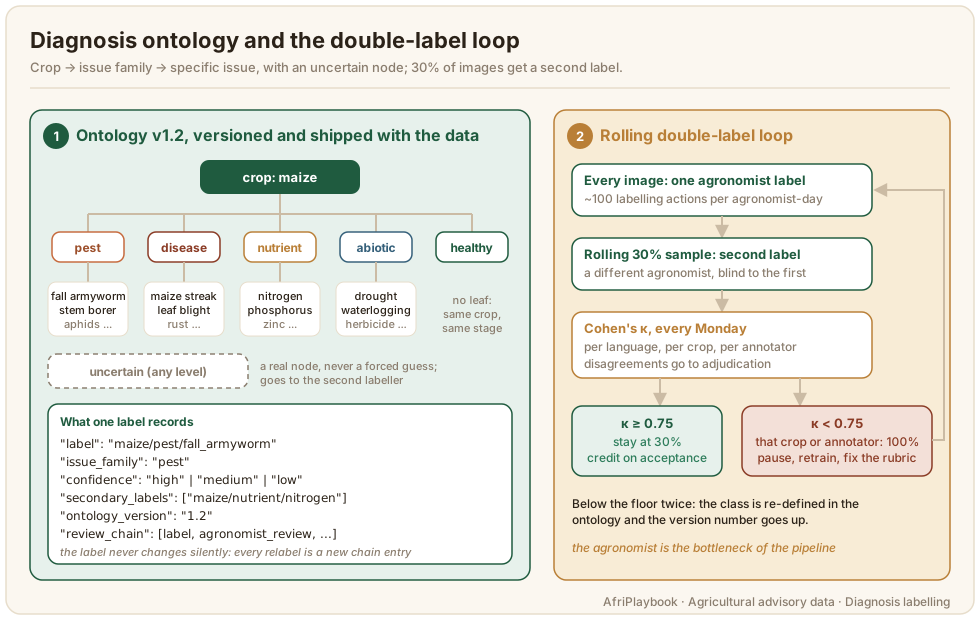
A label is a path through a versioned ontology plus a confidence, and a chain of who did what to it. The diagnosis block of a pair record:
"diagnosis": {
  "ontology_version": "1.2",
  "label": "maize/pest/fall_armyworm",
  "issue_family": "pest",
  "confidence": "high",
  "secondary_labels": ["maize/nutrient/nitrogen"],
  "review_chain": [
    { "stage": "label", "role": "agronomist", "reviewer_id": "agr-0142",
      "decision": "accept", "label_given": "maize/pest/fall_armyworm",
      "rubric_version": "hau-1.1", "timestamp": "2026-12-05T09:12:00Z" },
    { "stage": "label", "role": "agronomist", "reviewer_id": "agr-0207",
      "decision": "accept", "label_given": "maize/pest/fall_armyworm",
      "rubric_version": "hau-1.1", "timestamp": "2026-12-06T14:40:00Z" },
    { "stage": "agronomist_review", "role": "agronomist", "reviewer_id": "agr-0088",
      "decision": "accept", "rubric_version": "hau-1.1",
      "timestamp": "2026-12-09T11:05:00Z" }
  ]
},
"qa": { "status": "accepted", "double_labelled": true, "label_agreement": true }
The ontology. Three levels: crop, then issue family (pest, disease, nutrient, abiotic, healthy), then the specific issue as the leaf. healthy has no leaf; it means the same crop at the same stage with no issue. uncertain is a real node an agronomist can choose at any level, and confidence (high, medium, low) is recorded on every label. secondary_labels holds a second issue visible in the same image, common in the field where a nitrogen-starved plant also has armyworm damage. The ontology is versioned, and the version is written into every label, because the ontology will change during the project and a label from version 1.0 must not be read as if it came from 1.2.
The reviewer chain. Every action on the label is appended, never overwritten: the first label, the second label if the image was sampled, the reviewer's decision, and adjudication if the two disagreed. reviewer_id is opaque. rubric_version records which version of the language's rubric document applied, so a reviewer's decision can be read against the rules they actually had. qa.double_labelled and qa.label_agreement are what the weekly kappa is computed from.
Who does it and how
Agronomists. One agronomist partner per language, aligned with the national extension service, and enough agronomists under that partner to carry the throughput. The label must match what the extension service tells farmers, so the partner brings the standard: the Federal Ministry of Agriculture and Rural Development (FMARD) and state Agricultural Development Programme (ADP) guidelines with the Institute for Agricultural Research (IAR) Zaria for Hausa, the Kenya Agricultural and Livestock Research Organization (KALRO) and the Ministry of Agriculture and Livestock Development (MoALD) for Kiswahili in Kenya, and Ethiopian Institute of Agricultural Research (EIAR) packages for Amharic and Afaan Oromo. Ask the partner to confirm the ontology's leaf nodes against that standard before labelling starts.
The interface. The agronomist sees both shots, the collector's form with the suspected issue and the farmer's question, and the ontology as a hierarchical picker with the uncertain node and the confidence choice. The vernacular name of each node sits beside the English one. The agronomist can reject the image for quality, with a reason that goes back to the collector.
Double labelling. A rolling 30% of images goes to a second agronomist, blind to the first label. Disagreements go to adjudication by the language lead, who consults the agronomist partner on the label and escalates to the quality lead when the two cannot settle it. The worked example labels about 15,000 images this way, so roughly 4,500 get two labels.
Rubric ownership. The language lead owns one versioned rubric for the language: the ontology term list in the vernacular, worked examples per node, and the review checklist. A corner case that two agronomists read differently becomes a worked example in the next version.
On the platform
The screenshot below shows the labelling task in AfriAnnotate. The agronomist sees the photo and the farmer's question on the left, and sets the crop, the ontology diagnosis, the growth stage, the plant part, a confidence rating and the image quality on the right.
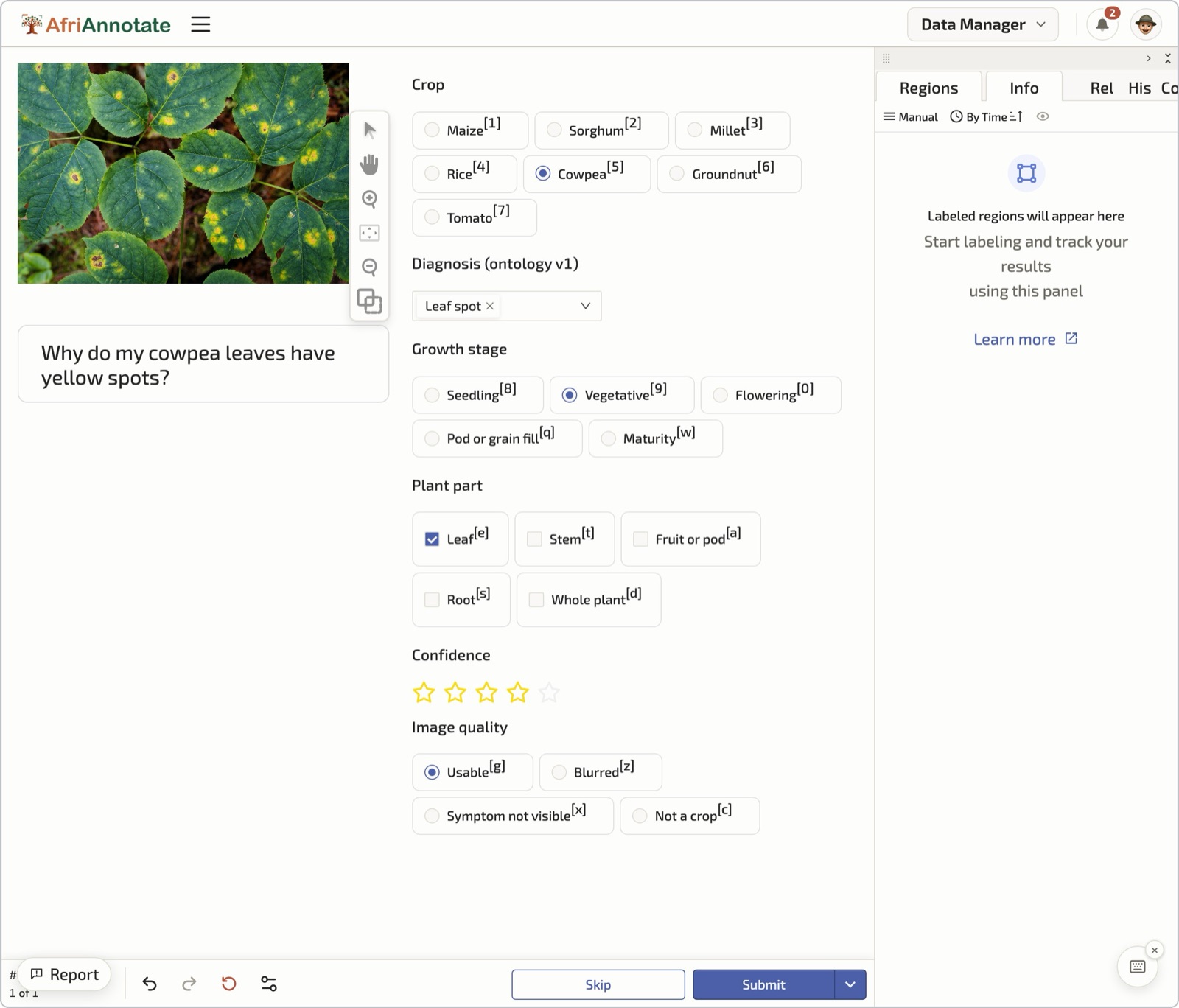
The photo is a stock image standing in for a field photo.
Guidelines that matter
- Label what the image shows. The collector's suspected issue is a hint; if you cannot see the evidence for it, do not label it.
- Go to the leaf if you can, stop at the family if you must. A confident
maize/diseasewithconfidence: mediumis worth more than a guessed leaf withconfidence: high. - Choose
uncertainwhen the image does not let you decide. Never force a label to clear the queue; an uncertain label goes to a second agronomist, a wrong confident one goes into the training set. - Record a secondary label when two issues are visible. Do not pick the one you think matters more and drop the other.
- Reject the image, with a reason, when it cannot be labelled: out of focus, wrong plant part, too far away. A rejected image is one lost photo; a mislabelled one leads to an advisory and a speech item built on a wrong diagnosis.
- Use the vernacular term list from the rubric, and flag a node whose vernacular name does not match what farmers in your district say. The advisory author will reuse it.
- Do not review your own labels. The platform blocks it, and if your tool does not, the language lead must.
Quality control
The kappa floor. Cohen's kappa is computed on the double-labelled sample per language, per crop and per annotator, every Monday, and the threshold is 0.75. Kappa corrects for the agreement two agronomists would reach by chance, which matters here because some crops have one dominant issue and raw agreement on them looks good even when the labelling is careless. Agreement is an exact match on the full label path: maize/pest against maize/pest/fall_armyworm is a disagreement, and uncertain is a label like any other. The 30% sample is drawn at random. Images that get a second label because the first was uncertain or confidence: low are double-labelled too, but they stay out of the kappa sample, so the metric measures routine labelling rather than the hard cases. Read the metric's caveats on the Workflow and Adjudication page before you set a floor for a smaller cohort.
The loop. While kappa holds above 0.75, the sample stays at 30% and labels are credited on acceptance. When any cell falls below the floor, that cell goes to 100% double labelling: every image of that crop, or every image by that annotator, gets a second label until the cell recovers. An annotator below the floor is paused automatically, retrained on the rubric's worked examples, and resumes on a short calibration set of gold images. A class that falls below the floor twice is a sign the class is badly defined, and the fix is in the ontology: split it, merge it or add worked examples, and raise the version number.
Gold images. Mix a small set of pre-adjudicated gold images into every agronomist's stream, unflagged. Ground-truth accuracy against gold gives a per-annotator read that does not wait for the weekly kappa.
The three-stage review. After labelling, every pair still passes the loop on the Quality, consent and release page, where an independent agronomist reviews the label against the extension standard. A relabel at review is a new entry in the chain, and the original label stays visible.
Adjudicating each disagreement as it arrives spreads the language lead's attention thin and hides patterns. Batching the week's disagreements by ontology node shows at once which node is the problem, and the fix is usually a worked example in the rubric.
Known limitations
- The ontology is a snapshot of one standard. Extension standards differ between countries that share a language and are revised over time. Ship the ontology with the data and never rewrite old labels to a new version silently.
- Kappa on a rolling sample lags. A drift that starts on Tuesday shows up the following Monday, with a week of labels already in the queue. Gold images shorten the lag.
- A photo is not a field visit. Some diagnoses need the root, the soil or the weather. The
uncertainnode andconfidence: loware the honest answers, and a model trained on this data inherits the same limit. - Agronomists disagree for real reasons. Two experts trained under different services can both be right about an ambiguous lesion. Keep the disagreement in the chain, as the adjudication page recommends.
- Throughput numbers are averages. A hundred actions a day assumes a good queue and a familiar crop. Plan for a slower pace in the first two weeks and for rare crops.
Further reading
- Field image capture: the form and the image the agronomist works from.
- Advisory authoring: what the author does with the label.
- Workflow and Adjudication: multiple annotators, agreement and adjudication in general.
- Annotation guidelines template: the section structure the language rubric follows, and the advisory-specific sheets for this chapter.
- AfriAnnotate: hierarchical taxonomy labels with an uncertain node, built-in kappa, annotator auto-pause and gold-task accuracy.